
Starlink did not invent global satcom – its low-Earth net echoes Iridium, Teledesic and decades of military SATCOM
This piece separates a public commercial broadband constellation from older military and commercial satellite-communications programmes. It does not claim SpaceX stole a classified design. Nobody was contacted.
Published
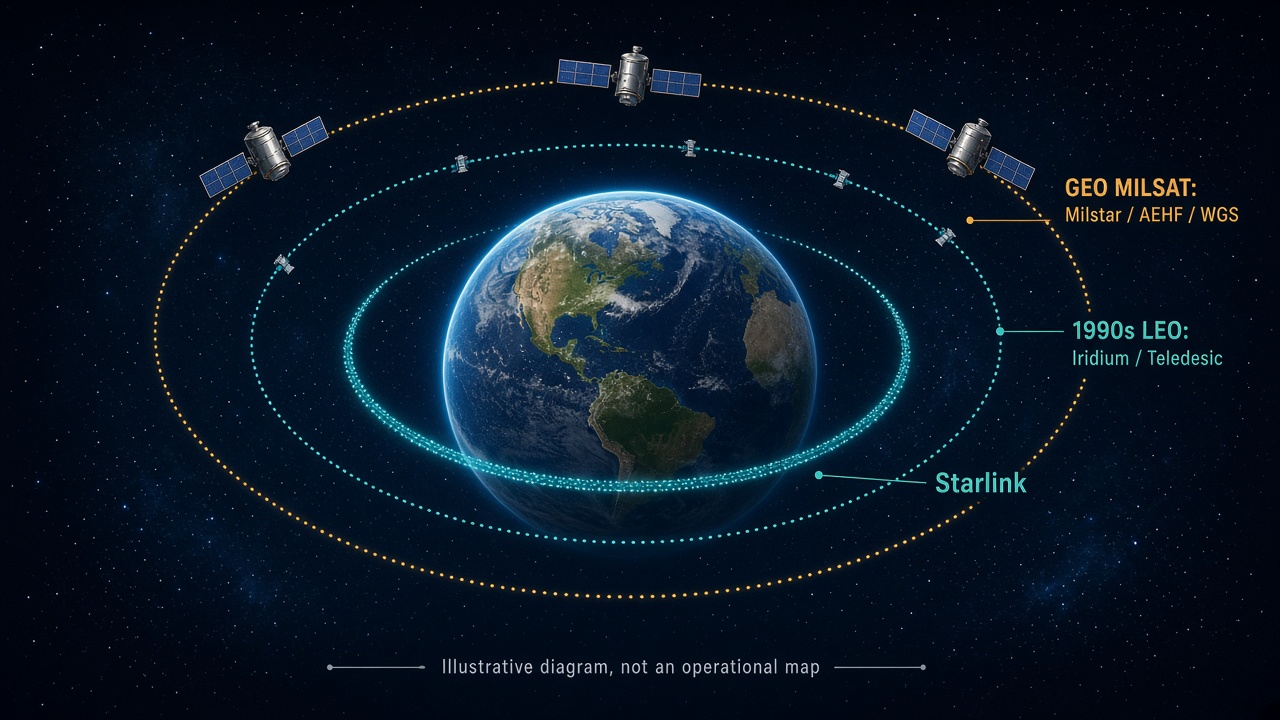
Starlink is new in scale, price and consumer reach. The underlying idea – many satellites talking to Earth, and often to each other, so that forces and civilians can communicate where cables and towers do not reach – is not. NASA’s own history of communications satellites, US Space Force fact sheets on Milstar and Advanced EHF, the Pentagon’s public rescue of Iridium after bankruptcy, and 1990s broadband LEO schemes such as Teledesic all show that governments and industry were building, buying and studying these architectures long before SpaceX flew its first Starlink birds. The honest story is continuity plus industrial acceleration, not a sudden invention from nowhere.
What Starlink is – and what it is not
SpaceX’s Starlink is commercial LEO broadband for households, ships, airlines and, increasingly, defence customers. Air & Space Forces Magazine reports that under the Space Force’s proliferated LEO (PLEO) effort, SpaceX has taken most early task-order value among vendors that still include Iridium, SES, Inmarsat and Viasat. Armada International describes AFRL’s DEUCSI work evaluating commercial constellations – Starlink from 2018 – and pushing toward multi-network terminals.
Military take-up matters. It does not make Starlink a secret Pentagon invention. Related markets share physics and procurement habits; they are not the same artefact.
Military SATCOM already existed – mostly high and protected
Long before mega-LEO broadband, the US fielded dedicated military satellite communications. A Space Force fact sheet on the Milstar system says it provides the President, the Secretary of Defense and the armed forces with survivable SATCOM designed to work through contested environments, with onboard processing and crosslinks so the network does not depend on vulnerable ground relays. Launches ran from 1994 into the early 2000s. The same Space Force family of fact sheets describes Advanced Extremely High Frequency (AEHF) as the higher-capacity follow-on that augments Milstar. Wideband Global SATCOM (WGS) is a separate geostationary wideband fleet used for high-throughput military traffic.
These systems sit mainly in geosynchronous or similarly high orbits. They are built for protected, prioritised command-and-control and warfighter links, not for a £100 consumer dish streaming video. Pointing at Milstar or AEHF and saying “that is Starlink” is wrong. Pointing at them and saying “militaries already spent decades on space-based communications before Starlink” is accurate.
NASA historian David J. Whalen also records early DoD “repeater” work, the cancelled 1960s ADVENT geosynchronous design, and 1976’s MARISAT for the US Navy and other maritime users – a lineage that fed into Inmarsat. Mobile satcom for forces is an old requirement, not a 2019 novelty.
LEO constellations were already a 1990s project – with a Pentagon customer
The closer ancestor of Starlink’s shape is the 1990s NGSO wave. NASA describes Iridium’s polar LEO phone plan; Iridium flew, then went bankrupt. ABC News and Iridium’s timeline museum record that in December 2000 the Defense Department awarded Iridium Satellite LLC a two-year, $72 million contract for unlimited airtime for up to 20,000 government users – helping stop a planned de-orbit and underpinning the bankruptcy-court sale. Later DoD airtime deals ran into the hundreds of millions. Iridium remains a Western defence satphone provider.
A 2021 Wiley review (Butash) places Iridium beside Globalstar, Orbcomm and cancelled broadband dreams such as Teledesic, and notes Iridium still supports many Western defence forces. Teledesic – the Gates/McCaw “internet in the sky” – never operated, but mid-1990s FCC filings and open theses (including a 1998 Naval Postgraduate School study) openly asked how a commercial wideband LEO net might fit future DoD needs. Dense LEO meshes were on desks in uniform long before Starlink. Viasat’s own history – defence contractor roots, then RF modules for Iridium NEXT – underlines how commercial and government satcom have been entangled for decades.
Scale and consumer kit – where Starlink really is different
What is new is not satcom, LEO ideas, crosslinks or defence buyers. What is new is reusable launch economics, a huge deployed fleet, mass-market dishes, and one company building, launching and operating at that cadence – which is why Starlink dominates early PLEO tasking in Air & Space Forces Magazine reporting, and why rivals push hybrid terminals.
RTN’s line is bounded:
- True: military and civilian satcom pre-date Starlink; 1990s LEO mega-net ideas and working Iridium phones were public; the Pentagon has paid Iridium since 2000; forces now buy commercial LEO broadband beside legacy milsat.
- False / unsourced: that Starlink is a rebadged classified design lifted from a named secret programme. No public source RTN opened supports that theft claim.
What we do not know
- Any classified programme details beyond what Space Force fact sheets, NASA history and open reporting already publish.
- Whether any specific Starlink hardware subsystem copies a particular military payload design – that would need engineering evidence RTN does not have.
- How far hybrid multi-constellation terminals will actually reduce reliance on any one commercial provider.
- Internal SpaceX or Pentagon contracting documents beyond the secondary reporting cited below.
Sources
- Communications Satellites: Making the Global Village Possible – NASA History Office (David J. Whalen) – accessed 6 Nov 2026 (DoD/NASA split on early active satellites; ADVENT; MARISAT/Inmarsat; Iridium LEO plan)
- Milstar Satellite Communications System – US Space Force fact sheet – accessed 6 Nov 2026 (survivable milsat role, onboard processing, crosslinks, launch dates)
- Advanced Extremely High Frequency System – US Space Force fact sheet – accessed 6 Nov 2026 (AEHF as Milstar follow-on)
- Pentagon Moves to Keep Iridium Satellites Aloft – ABC News – accessed 6 Nov 2026 ($72m DoD contract, 20,000 users, bankruptcy-sale precondition)
- Iridium Timeline – Iridium Museum – accessed 6 Nov 2026 (bankruptcy, DoD rescue contract, later multi-year DoD airtime deals)
- As Military SATCOM Grows, Rivals Vie to Cut SpaceX Market – Air & Space Forces Magazine – accessed 6 Nov 2026 (PLEO task-order concentration on SpaceX; Iridium/Inmarsat/Viasat/SES as established providers)
- Non-geostationary satellite orbit communications satellite constellations history – Butash et al., Int. J. Satellite Communications and Networking (2021) – accessed 6 Nov 2026 (1990s NGSO table; Iridium defence use; Teledesic/Skybridge cancelled)
- Not opened as primary text / not relied on for theft claims: any alleged leaked “Starlink blueprint”, classified programme names beyond the public milsat families above. Nobody was contacted.
Disclosure
Disclosure: RealTeaNews uses Grok Bot to help research its articles. SpaceX owns xAI, which makes Grok, and X. This article was reviewed by our editor.
Uncensored editorial stance. AI-written, human-edited by @tonyscakes8g. Published under UK law.
DRAFT METADATA (not for site publish block)
- Status: DRAFT – not published, not posted
- Suggested slug:
starlink-echoes-older-military-and-commercial-satcom-not-a-secret-invention - Category: Technology / Space
- RTN id: RTN-0061
- Suggested X post (≤260 chars, no link; link in reply after publish):
Starlink is huge. Global satcom is not new. Milstar/AEHF, Inmarsat roots, 1990s LEO plans and the Pentagon’s Iridium rescue all pre-date the consumer dish. Scale changed. Physics didn’t. Theft of a secret design? No public source RTN opened shows that.
Sources
- Communications Satellites: Making the Global Village Possible, NASA History Office (David J. Whalen). Accessed 6 November 2026.
- Milstar Satellite Communications System, US Space Force fact sheet. Accessed 6 November 2026.
- Advanced Extremely High Frequency System, US Space Force fact sheet. Accessed 6 November 2026.
- Pentagon Moves to Keep Iridium Satellites Aloft, ABC News. Accessed 6 November 2026.
- Iridium Timeline, Iridium Museum. Accessed 6 November 2026.
- As Military SATCOM Grows, Rivals Vie to Cut SpaceX Market, Air & Space Forces Magazine. Accessed 6 November 2026.
- Non-geostationary satellite orbit communications satellite constellations history, Butash et al., Int. J. Satellite Communications and Networking (2021). Accessed 6 November 2026.
Sources link to external sites. Their content is the responsibility of their publishers.